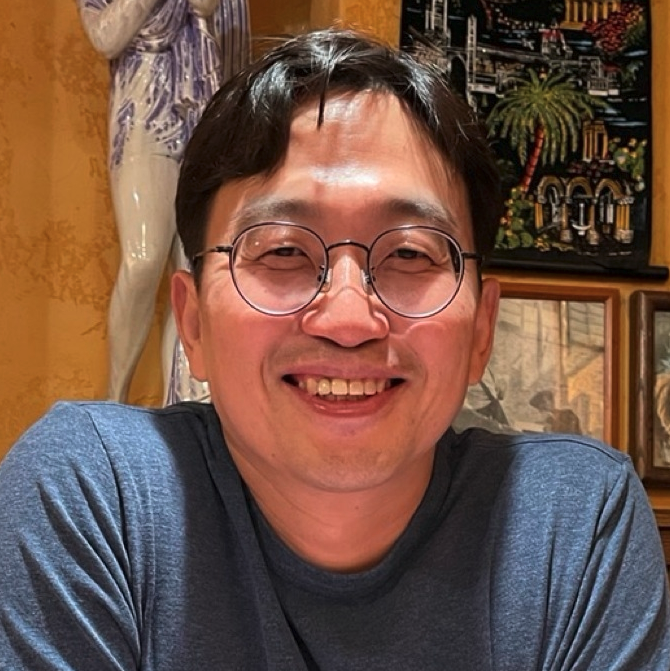
[SNUSV.NET Invited Lecture for Entrepreneurs] From Amazon AI to Gates Foundation Biotech - Three Pivots, Two Countries, One Mission in the Bio-Medical Revolution
Abstract
Why does an engineer and mathematician with a Stanford PhD in Convex Optimization, who spent 12 years optimizing semiconductor chips at Samsung and generated over $200 million in revenue through AI algorithms at Amazon, pivot to biotech? This talk traces an unconventional entrepreneurial journey across two big techs, two startups, two countries, and four seemingly unrelated domains—semiconductors, e-commerce, industrial AI, and life sciences—revealing that what appears random on the surface is actually a coherent evolution driven by a single thread: using mathematical optimization and AI to solve humanity’s most critical problems. From developing the iOpt platform still used by 300+ Samsung engineers today, to co-founding Gauss Labs as CTO and building industrial AI solutions for manufacturing, to establishing Erudio Bio and receiving a million-dollar Gates Foundation Grant for AI-powered drug discovery—each pivot wasn’t a departure but a deliberate expansion toward greater impact. The journey culminates in a profound realization: my strength lies not in being a pure expert in any single domain, but in being a connector who bridges mathematics, engineering, AI, and biology to create solutions that didn’t exist before.
The bio-medical revolution isn’t just about extending lifespan—it’s about optimizing the quality of life humans have already gained. Modern humans live 70-90+ years in bodies whose DNA makeup has been evolved for 30-40 year lifespans, creating an evolutionary mismatch that defines our era’s greatest challenge and business opportunity. Just as Jeff Bezos built Amazon on the durable truth that customers will always want lower prices and faster delivery, the bio-medical industry must be built on an equally fundamental insight: humans will always need solutions to live healthily throughout lifespans that far exceed what our biology was designed to support. This isn’t about precision medicine for the few—it’s about transforming healthcare through AI-powered platforms like Erudio Bio’s bioTCAD technology and VSA diagnostics to make early cancer detection and drug efficacy prediction accessible globally, especially to low- and middle-income countries (LMICs). Through partnerships with Stanford School of Medicine, Harvard Medical School, Seoul National University Bundang Hospital (SNUBH), Keimyung University Dongsan Hospital, Analog Devices (ADI), KAIST NanoFab, Korea Research Institute of Bioscience & BioTechnology (KRIBB) and others, we’re building infrastructure where AI augments human judgment rather than replacing it, ensuring that the bio-medical revolution serves human flourishing with equity and accessibility as foundational principles, not afterthoughts.
For student entrepreneurs dreaming of Silicon Valley, this talk offers hard-won lessons from the trenches: how to choose domains not by following trends but by identifying durable truths; why every “failure” and uncertainty hides unexpected gifts that only reveal themselves in retrospect; how to operate dual startups across Korea and the US while building ecosystems like K-PAI that became “the AI forum” in Silicon Valley within one year. You’ll learn the reality of pivoting from established tech giants to small(er) startups, the specific strategies that led to Gates Foundation validation, the cultural differences between Silicon Valley and Korean innovation ecosystems, and why building companies is ultimately about connecting people and creating meaning, not just developing technology. Whether you’re contemplating your first startup, considering a domain switch, or planning to enter the US market, this session will provide honest, actionable insights from someone who has lived through multiple pivots and emerged with a framework for entrepreneurship as an act of creation—where your unique combination of skills, no matter how disparate they seem, can become your greatest competitive advantage in solving problems that matter.
Another Version
Here’s what people don’t understand about my journey: the pivot from semiconductors to biotech wasn’t random—it was inevitable. I’m an engineer and mathematician who fell in love with Convex Optimization at Stanford, spent 12 years at Samsung building tools still used by hundreds of engineers, generated $200M+ revenue at Amazon through AI personalization, co-founded an industrial AI startup spun off from SK Group, and now lead Erudio Bio with Gates Foundation backing. On paper, these look like completely different careers. In reality, they’re all the same job: finding optimal solutions in complex systems—whether those systems are made of transistors, shopping cart algorithms, manufacturing processes, or cancer cells. The secret? I’m not an expert in a single domain. I’m a connector who bridges mathematics, AI, engineering, and biology with deep expertise in Convex Optimization and AI. Each pivot wasn’t abandoning what I learned—it was adding another layer to a capability stack that nobody else has, enabling me to solve problems at the intersection of fields where most people can’t even see the connection.
The bio-medical revolution is built on a durable truth most people miss: we’ve already won the longevity battle, but we’re losing the healthspan war. Humans now live 70-90+ years in bodies designed by evolution for 30-40 years. Every cell carries cancer probability negligible over short lifespans but increasingly significant over decades. Alzheimer’s, heart disease, cancers—these weren’t major evolutionary pressures because our ancestors didn’t live long enough to develop them. This evolutionary mismatch is the greatest business opportunity of our lifetime, but only if we approach it correctly. Not precision medicine for wealthy elites, but AI-powered platforms that democratize early detection and prevention globally. That’s why Erudio Bio applies semiconductor TCAD principles to biology, uses Dynamic Force Spectroscopy to generate 1000x more data per sample, and partners with institutions from Stanford School of Medical, Harvard Medical School, and Analog Devices (ADI) to Seoul National University Bundang Hospital (SNUBH) and Keimyung University Dongsan Hospital—we’re building the infrastructure where AI augments human compassion, not replaces it, making healthspan optimization accessible to everyone, especially those in low- and middle-income countries (LMICs) who need it most.
For SNUSV entrepreneurs, here’s what I wish someone had told me: entrepreneurship is terrifying, and that never stops—but the fear is worth it, and actually, it gets really exciting quite often if you know what you’re doing and how you should do them! When I left Samsung, people said I was crazy to give up Korea’s best job security. When I left Amazon for a small(er) startup, colleagues questioned my sanity. When I pivoted to biotech without a biology PhD, investors were skeptical. But soon enough, for every single case, they (finally) realized they were wrong. I was scared every single time. But here’s what nobody tells you: challenges aren’t about getting what you want—they’re about discovering gifts you didn’t know were waiting. Amazon taught me Silicon Valley culture and the power of scale. Gauss Labs awakened dormant business instincts. Erudio Bio made me the true owner of my time for the first time in my life and led to founding K-PAI, which became Silicon Valley’s go-to AI forum in under a year—completely unplanned. You’ll learn the real strategies for dual Korea-US operations, how Gates Foundation validation actually happens, why I’m now living the happiest moments of my life despite working 2-3x harder, and most critically: how to build companies that aren’t just successful but meaningful—where technology serves human flourishing, colleagues become partners in a larger mission, and your work contributes to a future where health, freedom, and equity aren’t privileges but universal realities.